

Popular Searches

Zoo news – July 2026
July, 2026
From bitter-sweet goodbyes to celebrating Bush-dgos and tigers, the zoo had quite an exciting month this July!
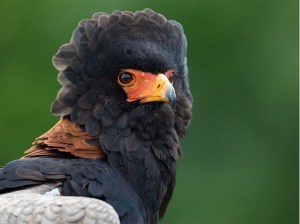
We wish Zulu, our Bateleur Eagle (Terathopius ecaudatus) all the best for new home in Germany
This month, we wished good luck to Zulu our 16-year-old Bateleur Eagle (Terathopius ecaudatus) on his journey to his new home in Deutsche Greifenwarte (German Raptor Research Centre) in Germany. With recommendations for the Taxon advisory groups and EEP (EAZA EX-Sit Programme) breeding coordinators, animals are transported to and from Zoos around Europe. These moves can be attributed to a variety of reasons such as participation in breeding programmes, moving to a zoo with more space or to ensure individuals are getting their social needs met.
In Zulu’s case, he is leaving for Germany to be part of a very important breeding programme, the EEP. He will be part of the first pairing of Bateleur Eagles, Deutsche Greifenwarte has seen. Breeding programmes such as the EEP are vital in creating a “safety net” for the species as they are currently listed as near threatened on the IUCN red list due to a variety of factors. These factors include the risk of pesticides, the loss of habitat, nest disturbance, and risk of capture for international trade.
Unlike many eagle species, the Bateleur is not found in areas of dense forest. The Bateleur (Terathopius ecaudatus) is widely distributed in Africa, south of the Sahara Desert and can be found all the way into South Africa, west to Cameroon, and east into southwest Arabia. Bateleurs fly in a unique way. When soaring, they rock their wings from side to side, almost as if they were constantly trying to regain their balance. This gives them their name, Bateleur, which translates to “street performer” or “juggler”.We wish Zulu all the best in his very exciting new Home
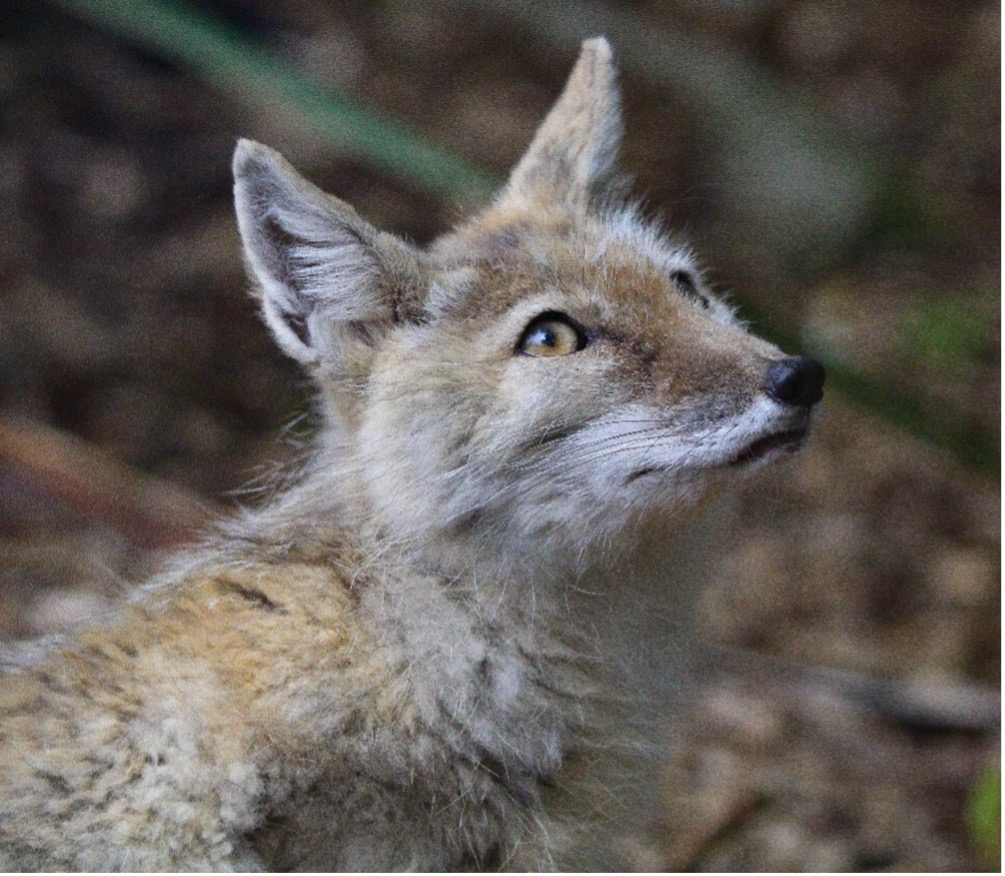
Saying Goodbye to our Beloved Corsac Fox (Vulpes corsac), Trip
We are saddened to announce the passing of Trip, our beloved Corsac Fox (Vulpes corsac). At one of his regular health checks, it was discovered that he had lung cancer. The average age of Corsac Foxes in the wild is roughly 6 to 9 years old, in the care of zookeepers, the average age is 12 years old. Trip had far surpassed this, passing away at the incredible age of 15. Trip was affectionately known as Tripod, named due to only having three legs. What he lost in limbs, he made up for in personality, leaving an impact on all who worked with him.
His favourite food and greatest reward in life was eggs, which he happily accepted during training time with his keepers. Only if training was on his terms as he was a very stubborn fox. Despite having three legs, Trip was the only member of his pack to stalk and try and catch any birds who had entered his habitat, proving his determination and intelligence until his final days.
In loving memory of Trip.
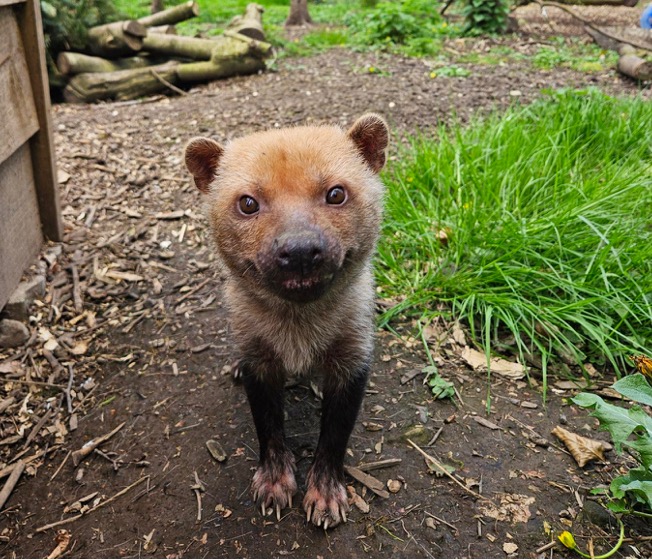
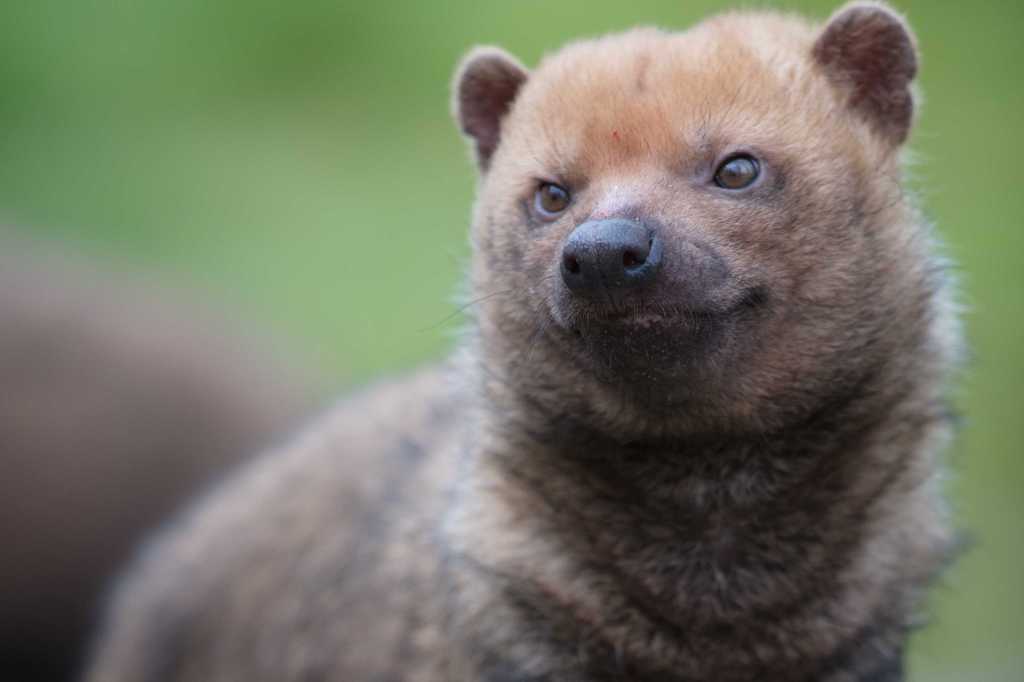
Photo of Missy, our Bush Dog mother to seven pups over the years – Rebecca Tull
This July we celebrated Bush-Dogs (Speothos venaticus) in our Annual Bush Dog Day Celebration.
On the 21st of July, we celebrated Bush Dog Day. Bush Dogs (Speothos venaticus) are the smallest pack hunting dogs who can live in groups of 12 individuals, primarily found in forests, but also inhabit grasslands, savannas, and even wetlands of South America.
Bush Dogs avoid open, exposed areas, utilising the forest canopy and underbrush as their primary hunting grounds as populations are often fragmented and localised due to habitat loss and human activity, classing them as Near Threatened by the IUCN Red List, proving importance of breeding programmes like the EEP.
On the day, we had an activity table to educate guests about these amazing animals with a scavenger hunt through the zoo, as well as talks throughout the day, showcasing training sessions, enrichment and feeding carried out by our zookeeper Rebecca. We currently have nine bush dogs, Missy and Pedro our breeding pair, and their offspring Maya, Aluna, Jorge, Callista, Yara, along with the newest arrivals Sansa and Ayra.
Ending July on a Roarsome High with Tiger Day! We celebrated our 18-year-old Amur Tiger (Panthera tigris altaica), Bira
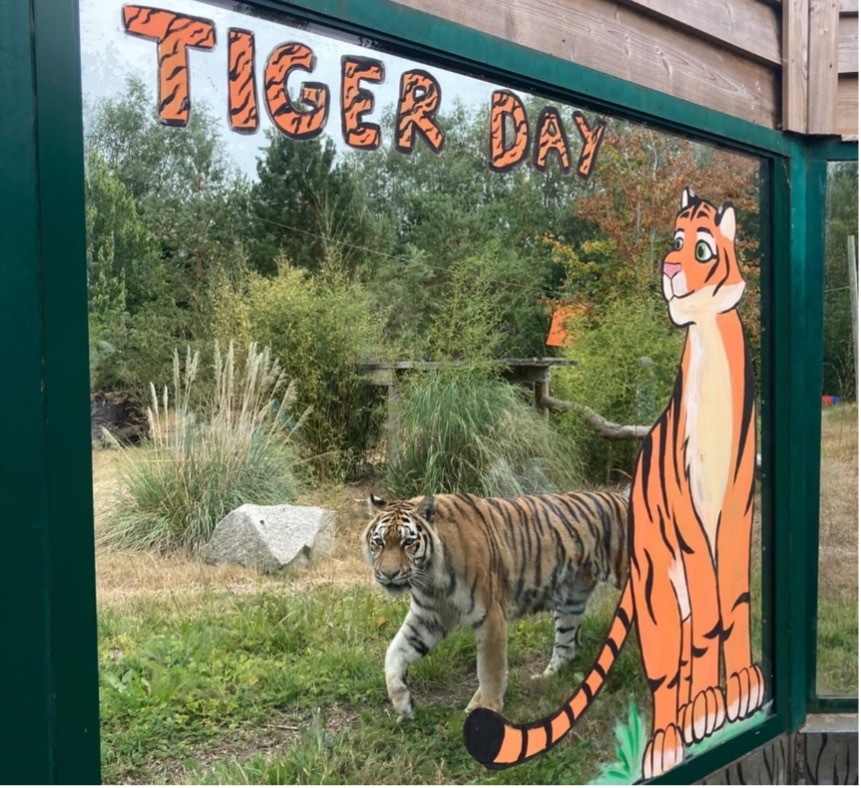
In the final week of July, we ended the month with a roaring success with the celebration of Tiger Day! Together we celebrated our female Amur tiger (Panthera tigris altaica), Bira who also celebrated her 18th birthday this year.
Amur tigers are the largest species of big cat in the world and inhabit the forested, mountainous valleys of the Amur region. As a tiger living in a temperate environment with less prey availability, Amur tiger males can defend an impressive territory size of 1000 km2! Amur tigers are obligate carnivores, only eating meat and their prey mainly consists of deer and wild boar. As a top predator, they are essential for managing these prey populations and exert top-down effects to regulate the ecosystem as a whole.
Amur tiger conservation has taken a paw-sitive turn in the past few decades through the cooperation of conservation organisations, ex-situ programmes and govermental projects. In 1940/50s there were only approximately 50 of these beautiful tigers left in the wild but most recent studies estimate a current wild population of 540 individuals! Despite this, the Amur tiger is still listed as Endangered by the IUCN Red List, indicating them as another crucial species in ex-situ programmes like the EEP.
On tiger day, we celebrated with our activity table and our exciting “Tiger trail” hunt to receive an exclusive tiger tracker certificate. We also had ongoing talks at Bira’s habitat with three major talks throughout the day where Bira received enrichment, including a postcard signed by some guests! We even held a competition for guests to win four free tickets to the park, raffled to all those who had guessed the correct age of Bira! Congratulations to all those than took part and thanks to everyone that joined us, but if you didn’t get a chance to see Bira this week, come join us all throughout August for our daily tiger talk at 3pm!
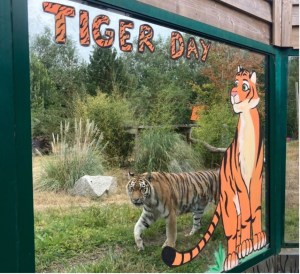
Photo of Bira, our Amur Tiger (Panthera tigris altaica) at our Tiger Day Window, painted by our Keeper Katie Catton – Charlotte Dillon
Songs of Summer – Wildlife Sightings this month
As temperatures rise, Irelands wildlife truly comes to life. With coasts busy with breeding season for our seabirds such as terns, puffins and gannets. On land, fox cubs are leaving dens, and the air is filled with our incredible native pollinators. Emerald Park is no different and our Discovery and Learning department has been busy with our pollinator counts this summer. This data is provided to the National Biodiversity Centre as part of the All-Ireland Pollinator Plan. This monitors Ireland pollinator populations to keep track of all our incredible species.
The most common sightings this month were two species of butterflies. The Small White and the Painted Lady. The Painted Lady (Vanessa cardui) is a long-distance migrant. Each year, it spreads northwards from the desert fringes of North Africa, the Middle East, and central Asia, recolonising mainland Europe and reaching Britain and Ireland. The Small White (Pieris rapae) This common butterfly is found in a variety of habitats, particularly gardens and allotments where cabbages are grown. Small whites are commonly found throughout the UK and Ireland.
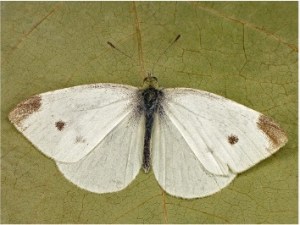
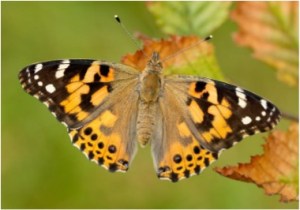
Photo – Examples of these two butterflies. Right is the Painted Lady (Vanessa cardui), and the Left is the Small White (Pieris rapae).
Come back next month to see what the Zoo got up to in August!