

Popular Searches

Zoo news – August 2026
From festivities celebrating wildlife, to new enclosures unveiled, check out what the Zoo got up to in August!
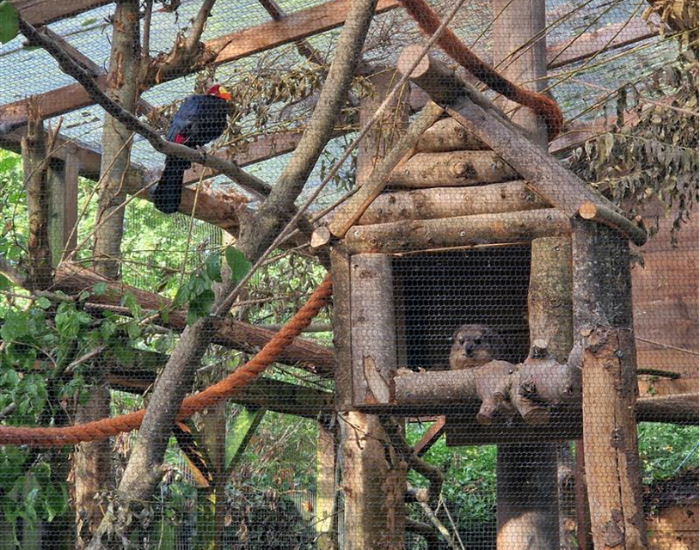
This month we unveiled our new mixed species enclosure with our Rock Hyrax and Violaceous Turaco!
This month we unveiled our new habitat. Both Tano, our Violaceous turaco and Dwayne, our rock hyrax moved into their new home together. Both species are found throughout Africa where their habitats naturally overlap. Having multiple species in one habitat is highly beneficial as it mimics natural social behaviours.
Violaceous turacos (Musophaga violacea) are found in forests and savannahs across Africa and are adapted perfectly to live there. Young turacos have a claw on their wing which helps them find balance as they move through dense canopies. They are omnivorous, feeding on fruit, insects, leaves and seeds.
Although a Rock Hyrax (Procavia capensis) may look like a rodent, its closest relatives are elephants and manatees. Their upper incisors grow continuously and look like small tusks. Their habitat ranges from dry savannahs to dense rainforests to the cold Afro-alpine moorland, mostly living along rock faces. Their rubbery damp feet are suitably adapted for climbing, allowing them to ascend steep rock faces.
Come and visit Dwayne and Tano in their new home!
Photo of Dwayne, our Rock Hyrax (Procavia capensis), and Tano, our Violaceous Turaco (Musophaga violacea). They are getting more used to each other by the day – Emma
Buzzing to bring back Big Bug Bonanza this August!
On the 15th and 16th of August, we celebrated Big Bug Bonanza. Ireland is home to an estimated 11,500 different species of insect, with the true number estimated to be closer to 16,000. Insects are pivotal in shaping and maintaining the integrity of natural environments, serving as pollinators, decomposers, and food sources for other species. To protect and preserve these creatures and ecosystems, we can take immediate actions such as rewilding our yards and balconies with native plants and flowers, greening cities with native trees and sustainably grown gardens, and stopping the use of pesticides.
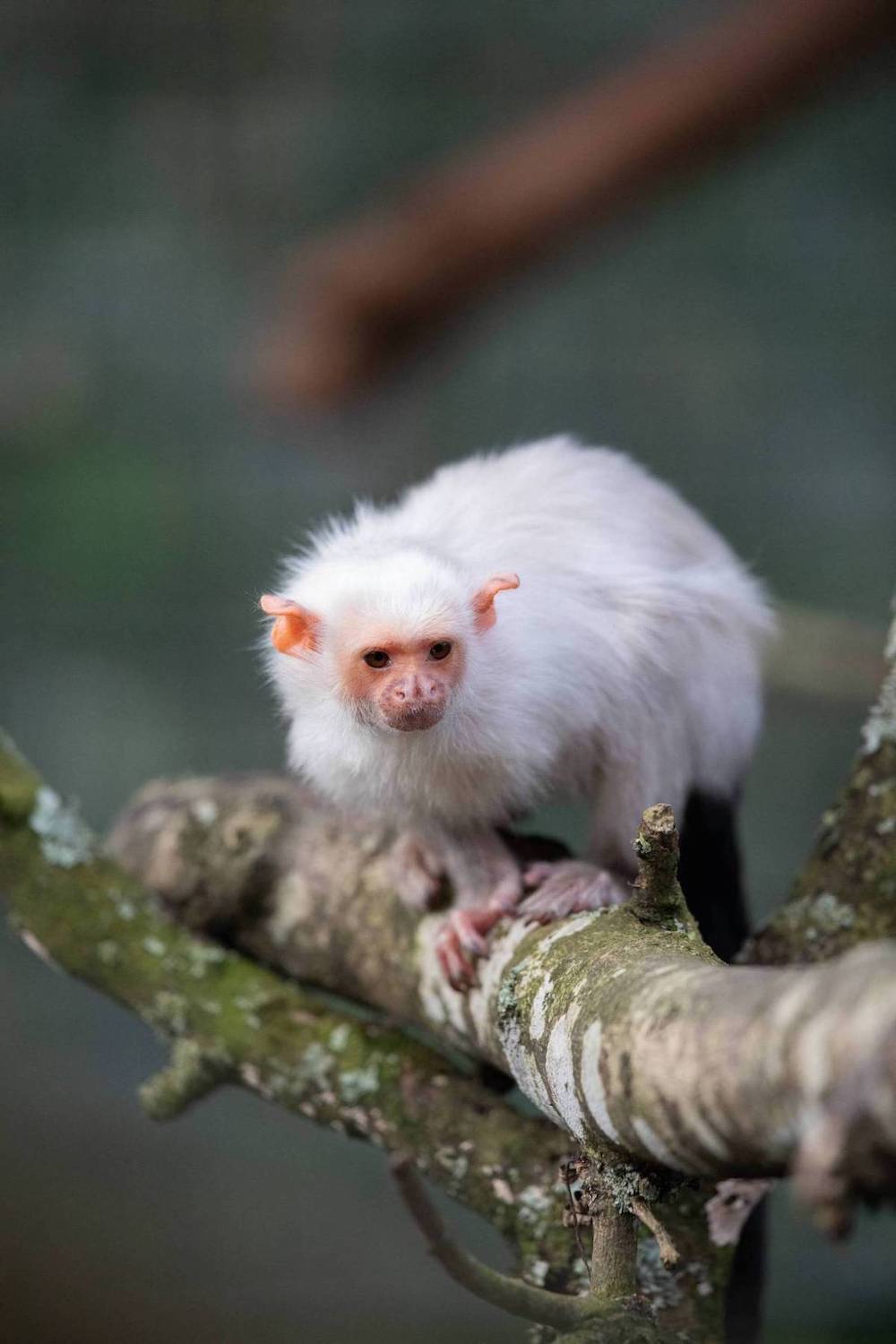
To celebrate this event, we had an array of themed games including a bug bingo. This involved a trail around the zoo in which guests could look for pictures of various species hidden in a variety of locations. Inside our education centre, we were joined by some very important guests, our crickets, beetles and locusts. Guests could see these incredible and vital species up close and learn more about their importance in ecosystems. Multiple species rely on insects as a food source, including our Goeldi’s monkeys (Callimico goeldii), Red bellied Tamarin (Saguinus labiatus) and our Silvery Marmosets (Mico argentatus). We added a talk on these primates to highlight how important insects are for the survival of many species.
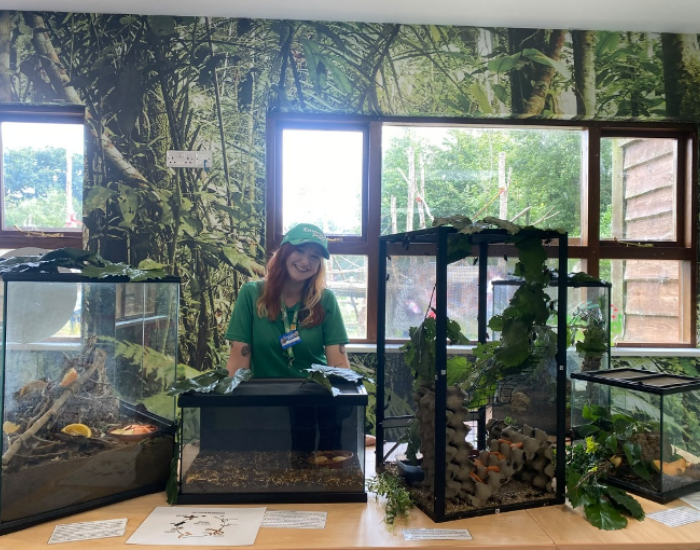
Photo of Nadine, D&L staff, with a variety of our live insects inside our Education Centre. These include Sun Beetles (Pachnoda marginata), Desert Locusts (Schistocerca gregaria) and Two Spotted Crickets (Gryllus bimaculatus) – Michaeala
On the week of the 17th of August, Heritage week kicked off in Emerald Park with a BANG!
The week starting on the 17th of August was the beginning of Heritage Week here in Emerald Park. This is an exciting event as Ireland is home to many important native species. Ireland has a wealth of wildlife with 27 native mammals, 5 native amphibian and reptile species, 450 bird species with a mix of year-round dwellers and migratory species and 11,500 insect species. That’s not to mention the 55 native plant species to celebrate here in Ireland!
To celebrate as many of these species we filled our Education Centre with lots of games and information on our native species and the importance they play in Irish culture throughout the ages. Colouring pages featuring animals from the Book of Kells were very popular. For those that never made it into our Education Centre for the fun, we had our Celtic Cart travelling around the Zoo. This was a trolley with many artefacts from native species such as faux fox fur and antlers from our native red deer. We also took this time to highlight some of our native species right here in the Zoo like our Red kites, White tailed Sea Eagle and our Eurasian Lynx.
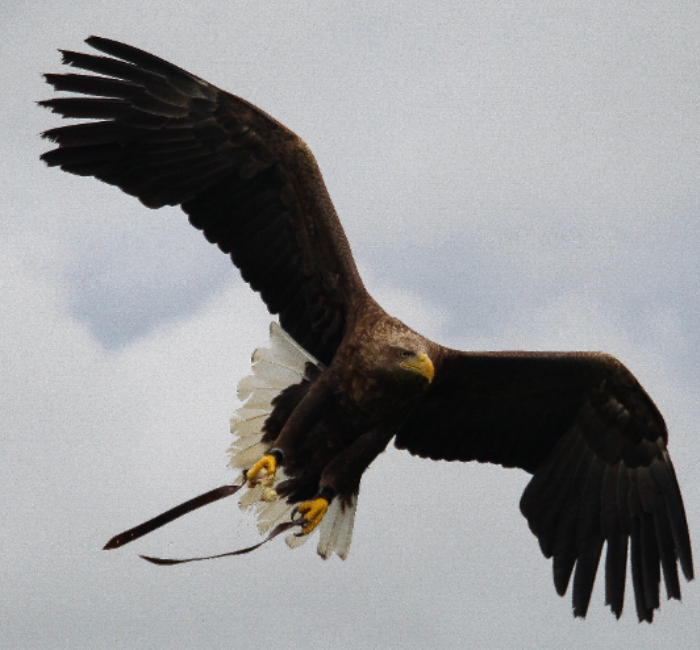
Photo of Max, our native Irish White-Tailed Sea Eagle (Haliaeetus albicilla) during our World of Raptors Display, highlighting his incredible flying skills – Lynn
Our two Southern Ground Hornbills, Henrietta and Albert were introduced this month into their new home together
Our two Southern Ground Hornbills (Bucorvus leadbeateri) have been introduced to one another and are now sharing the same habitat. This is excellent news as Hornbills are a social species often living in groups of up to 12. Henrietta is still a young female at only 7 years old while Albert is a mature male at 15 years old. Under the care of humans, these birds can live up to 70 years old so these two have plenty of time to get used to each other.
Southern Ground Hornbills are the largest species of hornbill with an incredible wingspan of up to 4 feet long! These birds are recognisable by their fleshy red throats, known as a wattle which identifies its gender. The throat of a male hornbill is completely red, whereas females have patches of violet blue.
Southern Ground Hornbills are listed as vulnerable by the IUCN (International Union for Conservation of Nature) red list. Threats to population include logging, pollution and agricultural expansion, unfortunately often into nesting habitats. Researchers estimate that the bird’s original range in South Africa has reduced by two thirds over the past century, and by a fifth in the past 15 years alone.
Come and see Henrietta and Albert in their new home together!
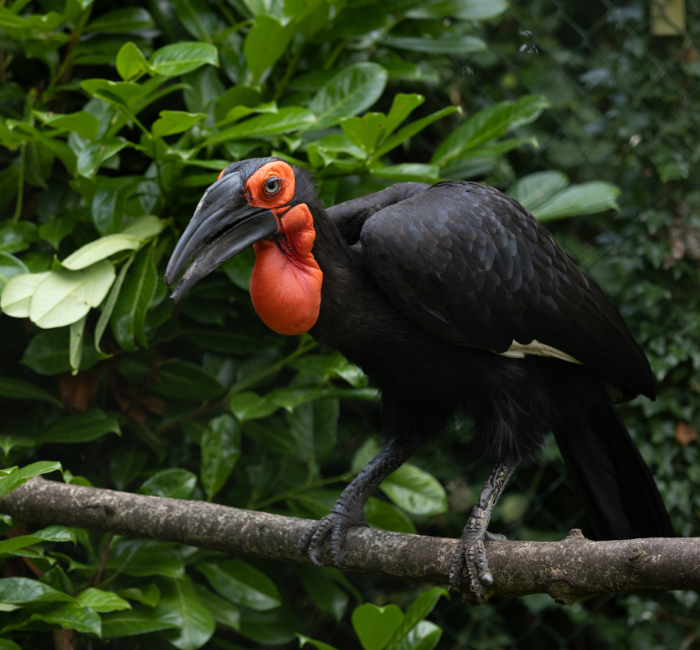
Southern Ground Hornbills (Bucorvus leadbeateri) Albert

Satana Health Check
This month, Satana our 21-year-old Sulawesi Crested Macaque (Macaca nigra) went to the vets for a very important procedure. Satana is a senior macaque who has unfortunately been experiencing some weight loss and lethargy. Her incredible vets performed a thorough workup (including ultrasound and blood panels) to pinpoint the cause. Her veterinary examination went smoothly with everything going according to plan. She is currently resting comfortably, and we are waiting on her diagnostic test results to get a clearer picture of her health. We thank Everyone at Veterinary Specialists Ireland for their ongoing care.
Sulawesi Crested Macaques are a primate species native to the tropical rainforests of Sulawesi, Indonesia, easily recognized by their jet-black fur, distinctive head crests, and highly social nature. Sulawesi crested macaques live in troops of 5-25 individuals with even larger size troops living in areas where there is an abundance of food sources. Sulawesi Crested Macaques are critically endangered with only 4,000 to 6,000 individuals on Sulawesi Island. Their population has decreased 80% in the last 30 years alone. Emerald Park has contributed to the important work of the Macaca nigra project through donating funds. €10,000 has been donated directly to the project to allow for education, research and monitoring of this species to ensure Sulawesi Crested Macaques are protected for future generations.
Photo of Satana, our 21-year-old Sulawesi Crested Macaque (Macaca nigra)
This month we wished our piglets good luck as they left Emerald Park…
Our Oxford Sandy and Black Piglets (Sus domesticus) piglets have grown up and are now old enough to move on to their next adventures. Kian, Mark, Nicky and Shane left our Zoo at the end of August. Although they only spent a short summer at the park, their personalities have left an impact on those who worked with them over the last few months.
Pigs are among the smartest domesticated animals, often considered more intelligent than dogs, with cognitive abilities comparable to a 3-year-old child. Pigs have poor eyesight, but a great sense of smell. Their nostrils are on their leathery snout, which is very sensitive to touch as they use their snout to search, or root, for food. The Oxford Sandy & Black Pigs is one of the oldest British pig breeds and has existed for 200-300 years.
We wish our four pigs’ good luck on their next adventures!
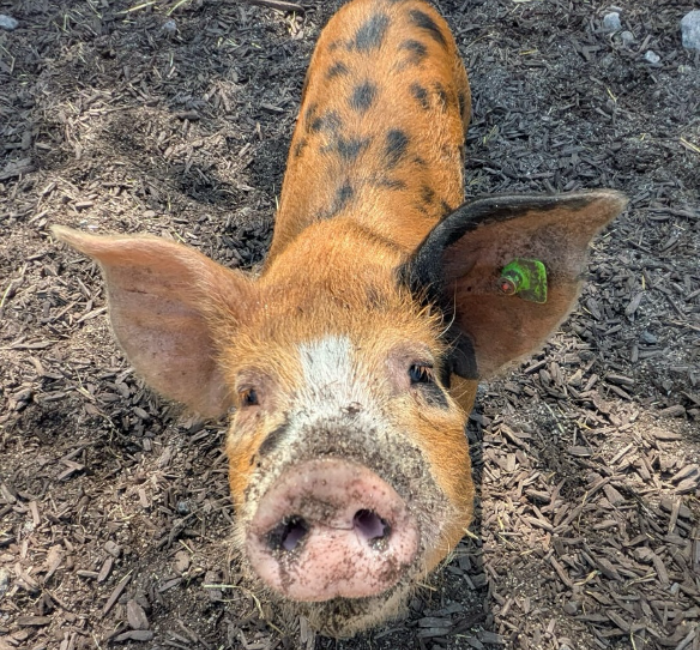
Photo of one of our Oxford Sandy and Black Piglets (Sus domesticus) – Andra Sticea
Check back next month to see what the Zoo Team got up to in September!
Thanks for reading!